Knowledge Check: Chapter 5
These are the key takeaways from Chapter 5.
Quiz Summary
0 of 5 Questions completed
Questions:
Information
You have already completed the quiz before. Hence you can not start it again.
Quiz is loading…
You must sign in or sign up to start the quiz.
You must first complete the following:
Results
Results
0 of 5 Questions answered correctly
Your time:
Time has elapsed
You have reached 0 of 0 point(s), (0)
Earned Point(s): 0 of 0, (0)
0 Essay(s) Pending (Possible Point(s): 0)
| Average score |
|
| Your score |
|
Categories
- Not categorized 0%
-
You have been unsuccessful in passing this exam. Don’t despair, review the course materials and keep trying!
- Return to the course by clicking here.
- To restart this quiz, click the button below.
-
Congratulations. You have passed this exam. You can now continue progressing through the course.
- Return to the course by clicking here.
- To restart this quiz, click the button below.
- 1
- 2
- 3
- 4
- 5
- Current
- Review
- Answered
- Correct
- Incorrect
-
Question 1 of 5
1. Question
Many people go boating after sunset, however boating at such a time presents a few issues, such as restricted visibility. So at these times, it just makes sense to switch on your navigation lights and slow your speed. Navigation lights help ensure you are visible to other vessels so collisions can be avoided. It’s really no different to headlights on a car. So, any time you find yourself with restricted visibility, such as night time boating, in fog or in the middle of a storm, light up your vessel (also heading back to shore until it clears up is a smart move).
Q: When should you switch on and display navigation lights on a vessel that is underway?
CorrectIncorrect -
Question 2 of 5
2. Question
Large commercial vessels exhibit day shapes to indicate safe side(s) of passage to other boaters. When a large vessel is anchored, it will hoist a black diamond high up on the mast, so it is visible from every angle (360 degrees).
Q: What type of shape must be hoisted in the forward part of a vessel greater than 7 metres in length to indicate it is at anchor?
CorrectIncorrect -
Question 3 of 5
3. Question
Navigation lights indicate that vessels position and direction of travel to other skippers. If you stop and throw out the anchor, you still need to display a navigation light; an all round white light to be precise. This light is a solid white light that is displayed above our vessel and must be visible from every direction (360 degrees). Red/green sidelights should be switched off when anchored.
Q: When anchoring a vessel less than 50 metres in length at night, which of the following lights must be displayed?
CorrectIncorrect -
Question 4 of 5
4. Question
A dredge is a vessel that digs up the seafloor to remove sand mud from the channel so future navigation of vessels is made safer. These dredges have large steel pipes to suck out all the mud and rocks it digs up. This present a significant navigation hazard to other vessels. Dredges will communicate this hazzard by exhibiting large black day shapes. These tell us how we should proceed safely around the vessel.
As covered in this chapter, day shapes are normally displayed upon a vessels high mast. On the diagram below we can see on the highest mast, there is a black ball above a diamond above another black ball. This simply indicates the vessel is restricted in its ability to manoeuvre, and nearby vessels should slow down and try to keep well clear of the dredge.
Below that, hanging from the boom, we can see two black diamonds on one side, and two black balls on the other. The black diamonds indicate to that this is the safe side to pass, whereas the two black ball indicate the side with navigation hazards, such as the dredges large steel pipes. Don’t navigate on the the side of the black balls.
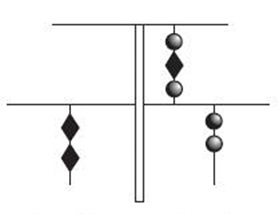
Q: You are preparing to pass a dredge displaying these signals. What action must you take?
CorrectIncorrect -
Question 5 of 5
5. Question
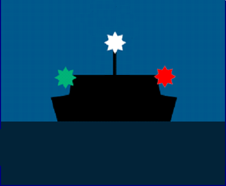
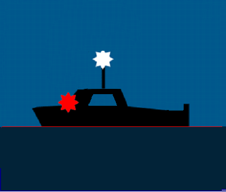
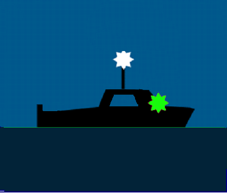
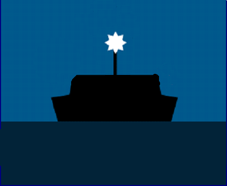
The purpose of this question is to ensure you know what other vessels are doing based purely off the navigation lights they’re displaying. Knowing their direction of travel helps us avoid a collision, and give way when required in the correct situations.
Q: It’s 9pm and you see a vessel with displaying the following lights. Click and drag the below answers to match up with the corresponding picture.
Sort elements
- The vessel is heading towards you.
- The vessel is on your right may be crossing your path. Your give way.
- The vessel is on your left and may be crossing your path. They give way.
- You are looking at the stern of a vessel.
CorrectIncorrect