
Knowledge Check: Chapter 4
These are the key takeaways from Chapter 4.
Quiz Summary
0 of 5 Questions completed
Questions:
Information
You have already completed the quiz before. Hence you can not start it again.
Quiz is loading…
You must sign in or sign up to start the quiz.
You must first complete the following:
Results
Results
0 of 5 Questions answered correctly
Your time:
Time has elapsed
You have reached 0 of 0 point(s), (0)
Earned Point(s): 0 of 0, (0)
0 Essay(s) Pending (Possible Point(s): 0)
| Average score |
|
| Your score |
|
Categories
- Not categorized 0%
-
You have been unsuccessful in passing this exam. Don’t despair, review the course materials and keep trying!
- Return to the course by clicking here.
- To restart this quiz, click the button below.
-
Congratulations. You have passed this exam. You can now continue progressing through the course.
- Return to the course by clicking here.
- To restart this quiz, click the button below.
- 1
- 2
- 3
- 4
- 5
- Current
- Review
- Answered
- Correct
- Incorrect
-
Question 1 of 5
1. Question
Maintaining a proper lookout is essential for all skippers not only to ensure safety of crew/passengers, but also to avoid a collision. If a crossing situation is developing, give way to your right-hand side (starboard). Do this early and substantially so the manoeuvre you’re undertaking is obvious to the other vessel. Remember, when crossing give way to the vessels on your right-hand (starboard) side. We’ve seen some absolute bellends try to cross in front of a vessel, it never ends well. So give way to your starboard, and cross behind the other vessel.
Q: A vessel is approaching on your starboard (right-hand) side and not changing bearing. What action should you take?
CorrectIncorrect -
Question 2 of 5
2. Question
Distance off rules are essential to keep all waterway users safe. If you are operating close to the shore, slow down to less than 5 knots. This speed is best described as a walking speed. Simply Wait until your vessel is further out from the shore before moving up the throttle. Knowing these distance off rules will help you keep everyone safe.
Q: On Victorian coastal and enclosed waters, within what distance from the water’s edge must you observe a speed limit of 5 knots, unless otherwise zoned?
CorrectIncorrect -
Question 3 of 5
3. Question
In this chapter, we covered why power driven vessels need to give way to sailing vessels most of the time regardless if they’re on your port or starboard side. This COLREG rule is needed due to the fact that sailing vessels are restricted in their ability to manoeuvre as they are largely dependant on the wind.
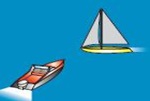
Q: Which vessel should give way in the situation pictured?
CorrectIncorrect -
Question 4 of 5
4. Question
Previously in this chapter, we learnt the collision regulations, which included keeping a safe distance from other vessels. When approaching a slower vessel from behind, it’s the responsibility of the overtaking vessel to keep well clear. If there’s not enough room to overtake AND keep a safe distance, wait until such a situation becomes available.
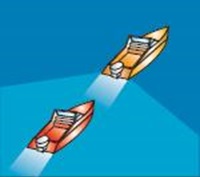
Q: When overtaking another vessel in the scenario shown:
CorrectIncorrect -
Question 5 of 5
5. Question
Large ships have limited visibility, particularly under their vessels bow. Large ships don’t have the same ability that you have to quickly manoeuvre out of the way. Simply for this reason alone, keep well clear of the larger vessels when at all possible. To mitigate the risk of a collision, ships will often use sound signals to communicate to other vessels in its vicinity. If you’re approaching a ship and hear five short horns blasts, this means that they’re unsure of your intentions and you need to take immediate and obvious action to get out of their ships way.
Q: You are operating your vessel in a channel when an approaching ship sounds five short blasts on its horn indicating that it is unsure of your intentions, and doubts you are taking enough action to avoid a collision. What should you do?
CorrectIncorrect